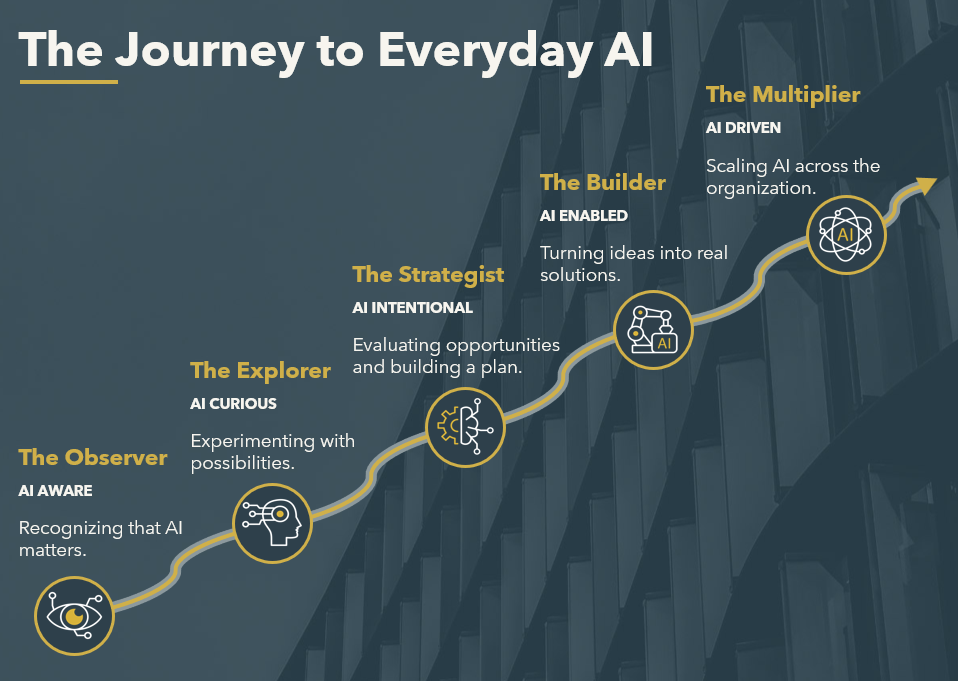
Introducing the Journey to Everyday AI, a practical framework for understanding your organization’s current capabilities and determining what should come next.
One Yardi organization is trying to reduce the time its finance team spends compiling reports and analyzing data in Excel. Another has employees experimenting with generative AI but little visibility into which tools they are using, what information they are sharing, or where those experiments are creating value. A third has already identified several promising use cases and is trying to determine whether its data, governance, and delivery practices are ready to support them.
All three organizations ask some version of the same question:
“Where should we start?”
It is a reasonable question. AI capabilities continue to expand, new tools arrive almost every week, and leaders are under growing pressure to move beyond conversation and demonstrate progress.
The problem is that the answer should not be the same for all three organizations because they are not starting from the same place.
Before an organization decides what to build, automate, deploy, or invest in, it needs an honest understanding of its current state. That includes the capabilities it has already established, the constraints that could prevent progress, and the organizational conditions required to turn an interesting AI idea into measurable and sustainable business value.
In other words, before asking where you should start, it helps to ask a more fundamental question:
Where are you today?
AI Initiatives Rarely Stall Because Organizations Lack Ideas
One of the biggest misconceptions I encounter is that organizations are struggling with AI because they do not have enough ideas.
Most do not have that problem.
Nearly every organization I speak with can quickly identify potential AI use cases across reporting, analytics, workflow automation, finance, operations, knowledge management, customer service, employee productivity, and training. Within Yardi organizations, those conversations may also include Voyager 8, Virtuoso, Yardi Data Connect, Power BI, Microsoft Copilot, purpose-built agents, external AI platforms, and other emerging capabilities.
The opportunities are not difficult to find. The harder questions come afterward.
Which opportunities address meaningful business problems? Which ones can produce measurable value? Is the necessary information accessible and trusted? Who owns the initiative? What governance is required? How will employees adopt the resulting capability? Who will support it after deployment? How will the organization decide whether the initiative succeeded?
Consider a real estate organization that wants to reduce the effort its finance and accounting teams spend preparing reports and analyzing spreadsheets. The future experience is not difficult to imagine. Leaders would have access to timely dashboards, users could investigate why a key metric changed, and conversational AI could help teams move from finding information to understanding it.
The visible use case is compelling, but the AI capability is only the surface of the effort.
Before that experience can become reliable, the organization needs to determine which reports and decisions matter most, where the required information resides, whether reporting definitions are consistent, who owns each source, how data should be accessed and secured, and who will support the new experience once it becomes part of everyday work.
The AI idea is often the easiest part.
The organizational conditions surrounding it determine whether it becomes useful.
The same principle applies when an organization considers Voyager 8, Virtuoso, Yardi Data Connect, Microsoft platforms, or another AI capability. Access to technology does not automatically establish a business priority, create trusted information, clarify ownership, produce user adoption, or define how value will be measured.
Technology can create the opportunity.
Readiness determines what the organization can do with it.
Different Starting Points Require Different Next Steps
There is no single path to successful AI adoption because organizations enter the conversation with different goals, priorities, data environments, leadership expectations, and internal capabilities.
A recommendation that is appropriate for one organization may be premature for another. Even organizations pursuing similar outcomes may require very different next steps.
Consider a Yardi organization that is still building foundational awareness. Leaders are hearing more about Voyager 8, Virtuoso, copilots, agents, and embedded AI capabilities, but the organization has not developed a common understanding of what those technologies mean for its people or processes. Different stakeholders may be using the same terminology in different ways, and excitement may be mixed with uncertainty.
That organization’s next step may not be an implementation. It may need education, leadership alignment, initial guidance for employees, and a clearer understanding of where AI could realistically support the business.
Another organization may already have employees experimenting with generative AI. Individuals are using tools for drafting, research, summarization, or analysis. Finance has reporting ideas. Operations sees opportunities for automation. Technology is evaluating platforms and integrations.
This organization has momentum, but it may not have visibility. Leaders may not know which tools are being used, which experiments are producing useful results, what information is being shared, or how isolated successes connect to broader organizational priorities.
Its next step may be to coordinate that experimentation, establish appropriate guidance, collect potential use cases, and identify which activities deserve further investment.
A third organization may have moved beyond exploration. Leadership can articulate desired outcomes, such as reducing manual reporting, providing faster access to information, improving decision-making, or accelerating a recurring workflow. The organization is not looking for another list of AI possibilities. It needs help translating ambition into a practical roadmap.
For this organization, the work may involve clarifying business priorities, understanding the required data foundation, evaluating the roles of Yardi and adjacent technologies, assigning ownership, defining decision points, and establishing how results will be measured.
A more established organization may already be implementing AI-supported solutions and thinking about what happens after the first successful pilot. It may want initial strategic and delivery support, followed by a transition that enables its own employees to maintain and expand the work.
That goal requires more than technical implementation. It requires internal ownership, defined support practices, capable teams, adoption planning, governance, and a repeatable way to move future ideas from initial concept into supported operational use.
These organizations are not separated by their interest in AI. All four may be equally enthusiastic.
They are separated by the capabilities they have established and the challenges standing between interest and repeatable value.
Introducing the Journey to Everyday AI
Although every organization’s AI journey looks different, the challenges are often surprisingly similar.
We repeatedly encounter organizations that are building awareness, experimenting with tools, aligning priorities, implementing solutions, or establishing the capabilities needed to scale what works. Those recurring patterns led us to develop the Journey to Everyday AI.
The Journey to Everyday AI identifies five recognizable stages of organizational capability: Observer, Explorer, Strategist, Builder, and Multiplier.
These stages are not grades. They are not labels for whether an organization is good or bad at AI. They describe the capabilities an organization has established, the challenges that commonly emerge at that point, and the questions leaders should consider when deciding what comes next.

The Observer: AI Aware
Observers recognize that AI is becoming an important part of business and industry conversations, but they are still building their foundational understanding.
Questions often outnumber answers, and the organization may be working to separate meaningful applications from market hype.
Within a Yardi organization, this may mean attending webinars, learning about Voyager 8 and Virtuoso, and hearing about copilots, agents, and embedded AI capabilities without having connected those developments to an agreed-upon organizational priority.
The central question at this stage is:
What could AI realistically mean for our people, processes, and Yardi environment?
The immediate opportunity is to establish a common language, build practical awareness, and create safe ways for people to learn.

The Explorer: AI Curious
Explorers have begun experimenting. Individuals or teams are testing generative AI, evaluating tools, exploring use cases, and discovering what may be possible.
The challenge is that this activity is often fragmented. Successful experiments may remain isolated, expectations may be inconsistent, and the organization may have limited visibility into what employees are doing or learning.
Within a Yardi organization, different departments may be considering reporting improvements, workflow automation, information retrieval, document analysis, or AI-supported decision-making. Leaders may also be evaluating both Yardi and non-Yardi capabilities without a common way to compare them.
The central question at this stage is:
Which experiments are revealing meaningful opportunities, and what guidance do we need around them?
The next step is often to turn scattered experimentation into coordinated learning and begin identifying where AI can create genuine business value.

The Strategist: AI Intentional
For Strategists, AI is no longer just a curiosity. It is becoming a deliberate business priority.
Leadership is evaluating opportunities, aligning around desired outcomes, considering risks, and determining where investment should be focused. The organization may already have a long list of potential use cases, but it needs a practical way to prioritize them.
Within a Yardi organization, this may involve opportunities such as reporting modernization, faster access to information, workflow improvement, or better integration of information across systems. Leaders may be evaluating whether the path involves existing Yardi capabilities, Yardi Data Connect, Microsoft platforms, external AI tools, or some combination of them.
The central question at this stage is:
Which opportunities should enter our roadmap, and what foundations must support them?
The Strategist’s challenge is turning ambition into an actionable plan that connects AI initiatives to measurable outcomes and organizational priorities.

The Builder: AI Enabled
Builders are turning ideas into operational capabilities. Pilots, automations, AI-supported workflows, and reporting solutions are moving from discussion into use.
At this stage, the focus shifts. Identifying opportunities remains important, but implementation alone is no longer enough. The organization must also address adoption, ownership, support, measurement, integration, and governance.
Within a Yardi organization, this might mean implementing AI-supported reporting, deploying embedded capabilities, automating parts of a recurring workflow, or connecting Yardi information to an adjacent analytics or AI platform.
The central question at this stage is:
How do we turn promising solutions into supported ways of working?
The Builder begins establishing the repeatable practices needed to move beyond isolated successes.

The Multiplier: AI Driven
For Multipliers, AI is becoming part of the organization’s operating model rather than remaining a collection of individual projects.
Successful practices are being expanded across departments. Governance is integrated into the lifecycle of new solutions.
Teams understand how to identify, evaluate, deliver, support, and improve AI-enabled capabilities. The organization is also developing the ability to respond as technology, business priorities, and risks continue to evolve.
Within a Yardi organization, this means more than using multiple AI tools. It means repeatedly connecting investments in Yardi and adjacent technologies to meaningful business outcomes while empowering internal teams to sustain and expand successful practices.
The central question at this stage is:
How do we scale what works while continuing to adapt responsibly?
AI is no longer treated only as a project. It is becoming a business capability.
It is important to recognize that these archetypes are not fixed identities or permanent destinations.
An organization may be a Strategist overall while demonstrating Builder-level capabilities in data and technology and Explorer-level capabilities in governance or adoption.
Progress is not always linear, either. A new technology, acquisition, leadership change, regulatory requirement, data source, or use case may reveal a capability that needs to be strengthened again.
The purpose of the framework is not to rush every organization toward Multiplier.
The purpose is to help leaders determine which capabilities matter most at their current stage and what progress should realistically look like from where they are today.
AI Readiness and Yardi Solution Fit Are Connected, but Different
One important distinction is that organizational AI readiness and Yardi-specific solution fit are related, but they are not the same thing.
Readiness describes the organization’s ability to pursue AI responsibly and sustainably. It includes leadership alignment, use-case discipline, data foundations, governance, skills, adoption, execution, and measurement.
Yardi-specific fit concerns the particular business problem being addressed, the data and workflows involved, the organization’s existing environment, its technology roadmap, and the type of value it is trying to create.
Two organizations may both want faster financial insights.
The first may still need to establish consistent definitions, clarify the ownership of key reports, and create a dependable reporting layer.
The second may already have a trusted data foundation and be ready to add conversational analysis, automate part of the workflow, or expand insights to a wider group of users.
The desired outcome is similar.
The appropriate next step is different.
This is why maturity alone should not prescribe a technology choice. An organization at a particular stage should not automatically implement a specific Yardi product, platform, or AI tool. The Journey helps explain the organization’s capabilities and constraints. The business problem and operating environment determine which solutions may fit.
The strongest decisions consider both.
AI Readiness Is Broader Than Technology
A maturity assessment that focuses only on tools will miss many of the factors that determine whether AI produces sustained value.
Technology matters, but so do leadership, priorities, governance, ownership, people, and execution. Sustainable progress depends on how those capabilities work together.
For that reason, our AI Readiness & Maturity Assessment evaluates six connected dimensions.
Strategy & Leadership
This dimension considers whether leaders have defined why the organization is pursuing AI, which outcomes matter, who is responsible, and how priorities will be established. The central question is:
Have leaders aligned around what AI should accomplish?
Use Cases & Value
This dimension evaluates how opportunities are identified, prioritized, validated, and connected to measurable business outcomes.
For a Yardi organization, that could include reducing reporting effort, improving decision-making, accelerating an existing workflow, or making information easier to access and understand. The central question is:
Are AI opportunities connected to business value, or are they being pursued primarily because the technology is available?
Data & Technology Foundation
This dimension considers whether the required information is accessible, trusted, understood, appropriately secured, and supported by a suitable architecture.
Readiness does not require perfect data. It requires enough shared context and reliability to support the business outcome being pursued. The central question is:
Can people and systems reliably access and understand the information the use case requires?
Governance & Operating Model
This dimension evaluates policies, oversight, decision rights, risk management, accountability, acceptable use, and lifecycle ownership.
Governance is not simply about slowing initiatives down or preventing people from experimenting. Good governance helps an organization move forward with greater confidence because expectations, responsibilities, and boundaries are clearer. The central question is:
Are ownership, oversight, and accountability clear enough to support responsible progress?
People, Skills & Adoption
This dimension considers AI literacy, role-relevant skills, employee confidence, enablement, change support, and the organization’s ability to integrate new capabilities into everyday work.
A solution can function technically and still fail to create value if people do not understand it, trust it, or incorporate it into their work. The central question is:
Are employees prepared and supported to use new capabilities effectively?
Execution, Measurement & Scale
This dimension evaluates whether the organization can move an opportunity from concept through validation, deployment, support, measurement, and responsible expansion. The central question is:
Can the organization turn a promising idea into supported operational use and repeat that process again?
The goal is not to achieve a perfect score in every dimension before doing anything with AI.
The goal is to understand how these capabilities influence one another and identify which strength can help accelerate progress and which constraint is most likely to hold it back.
An organization may be very effective at identifying attractive use cases but lack the governed data or ownership needed to deploy them. Another may have a strong technical foundation but no shared priorities. Both organizations are interested in AI, but they should not receive the same recommendation.
Why We Built the AI Readiness & Maturity Assessment
In many advisory conversations, leaders can describe where they want AI to take the organization.
The harder conversation is often about the current state.
Members of the same leadership team may have very different views of how mature the organization is, which capabilities are strongest, where experimentation is already happening, and what is preventing progress.
One leader may view the organization as an Explorer because teams are actively testing tools. Another may see it as a Strategist because leadership has begun discussing priorities. A technology leader may point to a strong data platform, while operational leaders may be more concerned about ownership, adoption, or the ability to move initiatives into everyday use.
Those perspectives are not necessarily contradictory. They may be revealing different parts of the same organization.
We built the AI Readiness & Maturity Assessment to create a more structured starting point for that conversation.
The assessment identifies an organization’s overall Journey to Everyday AI archetype and evaluates readiness across the six connected dimensions. The resulting profile highlights areas of relative strength, surfaces the capability most likely to constrain progress, and offers practical recommendations for what the organization should consider next.
After reading the five archetypes, many leaders will already have an instinct about where their organization sits.
The assessment provides an opportunity to test that instinct.
In some cases, the result may confirm what the organization already believes. In others, it may reveal that visible experimentation has moved faster than governance, that a strong technology foundation lacks aligned business priorities, or that employees are ready to adopt new capabilities but execution practices have not yet caught up.
The result is not a certification, compliance review, formal audit, or judgment of whether the organization is good or bad at AI.
It is a directional planning tool designed to support better conversations, more deliberate prioritization, and a clearer understanding of what should come next.
For Yardi organizations, that understanding creates a stronger foundation for decisions involving Voyager 8, Virtuoso, Yardi Data Connect, reporting modernization, Microsoft platforms, automation, and Yardi-connected AI use cases.
The assessment does not prescribe one product.
It helps create the organizational context needed to evaluate those options more intelligently.
Know Where You Are Before Deciding What Comes Next
“Where should we start?” will continue to be one of the most common questions leaders ask about AI.
The honest answer is that it depends.
It depends on the outcomes the organization wants to achieve, the capabilities it has already established, the constraints it needs to address, and the pace of change its people can realistically support.
The goal is not to move through the Journey to Everyday AI as quickly as possible.
The goal is to build the capabilities required to create value responsibly, repeatedly, and at a pace the organization can sustain.
Every organization’s journey will look different. The technologies selected, business problems prioritized, and timing of investment will vary.
But the first step is remarkably consistent.
Before deciding where AI should take the organization, develop an honest understanding of where the organization is today.
The Journey to Everyday AI provides a language for that conversation.
The AI Readiness & Maturity Assessment turns it into an actionable starting point.
Where Is Your Organization Today?
Take the AI Readiness & Maturity Assessment to identify your organization’s current archetype, evaluate readiness across six connected capabilities, and receive personalized guidance about what to consider next.
Attending YASC? The assessment will also be available as a starting point for conversations about AI readiness, Yardi-connected opportunities, and your organization’s path to Everyday AI.

Shawn Powers
AI Advisory Consultant
Connect with me on LinkedIn or book some time with me to discuss how your organization can unlock the value of AI in Yardi today!



Gelbgroup Consulting | AI Advisory Services